
We have beeen a 1E partner, and now TeamViewer, for over 18 years. Through that time we have seen the market shift and technology evolve, particularly in the end user computing space which is our main focus. There was much excitement when TeamViewer announced the acquisition of 1E. For us there was an acknowledgement that being in the stable of a brand that the market recognised and was widely known, could only be beneficial to the traditional 1E business. However, there was a nagging doubt, which almost bordered on comical. For years, 1E had banged on the drum that you shouldn’t have to remote into devices as it impacts the end user and wastes time. This was at the core of their value proposition, an incredible automation engine that fixes things before they break, why remote, it is antiquated? And as we know, TeamViewer is known as the remote company, we have all used it over the years, in many forms, including fixing mom’s laptop in Covid times. We sensed a conundrum, how were these diametrically opposed solutions, at face value, going to come together into a single cohesive solution?
What is emerging is one of the most compelling value propositions in the market today, a solution that at its core, continually and infinitely transforms the way end user computing services should be delivered. We needn’t have worried.
Navigating the Conundrum
Traditionally, the narrative around remote support had been a double-edged sword. While indispensable for troubleshooting, reliance on remote tools can inadvertently lead to a perception of dependency, intrusion and a lack of speed, contradicting the traditional messaging of 1E, which championed eliminating the need for such tooling. And herein lies the genius of TeamViewer’s approach: rather than viewing remote support and DEX as mutually exclusive, the Infinity Loop integrates them into a symbiotic relationship which places them in a unique position in the market. In our opinion, nobody can touch them.
Industry Standards and TeamViewer’s Unique Approach
In the realm of end-user computing, industry standards often gravitate towards specialized solutions—either focusing on robust remote support or advanced digital experience management. Many competitors excel in one domain while compromising on the other. This fragmented approach can lead to inefficiencies, where the lack of integration between remote support and DEX insights results in prolonged downtimes and user dissatisfaction.
Remote Support vs. DEX:
- Traditional Remote Tools: These often prioritize immediate problem-solving but lack proactive capabilities. They are reactive by design, addressing issues only after they arise, which can lead to repetitive interventions and increased dependency.
- DEX-focused Platforms: While these platforms excel in user experience management and predictive analytics, they sometimes fall short in providing comprehensive support solutions, especially for complex technical issues that require expert intervention.
TeamViewer’s Competitive Edge
TeamViewer stands out by bridging this gap through its Infinity Loop. By integrating AI-driven remote support with real-time DEX insights, TeamViewer not only resolves current issues but also anticipates future problems. This dual capability ensures a seamless user experience that competitors often struggle to offer.
- Proactive Problem Solving: TeamViewer’s real-time data analytics and AI-driven insights allow it to predict and resolve issues before they impact the user, a capability often missing in traditional remote tools.
- Holistic User Experience: By combining remote access with DEX insights, TeamViewer ensures a holistic approach that enhances productivity and satisfaction, aligning with both IT objectives and end-user needs.
In essence, while competitors may offer excellence in isolated aspects, TeamViewer’s integrated approach ensures comprehensive service delivery. This not only sets a new standard but also redefines expectations in the end-user computing market.
The Infinity Loop: The quest for zero defect
So how does this all come together?
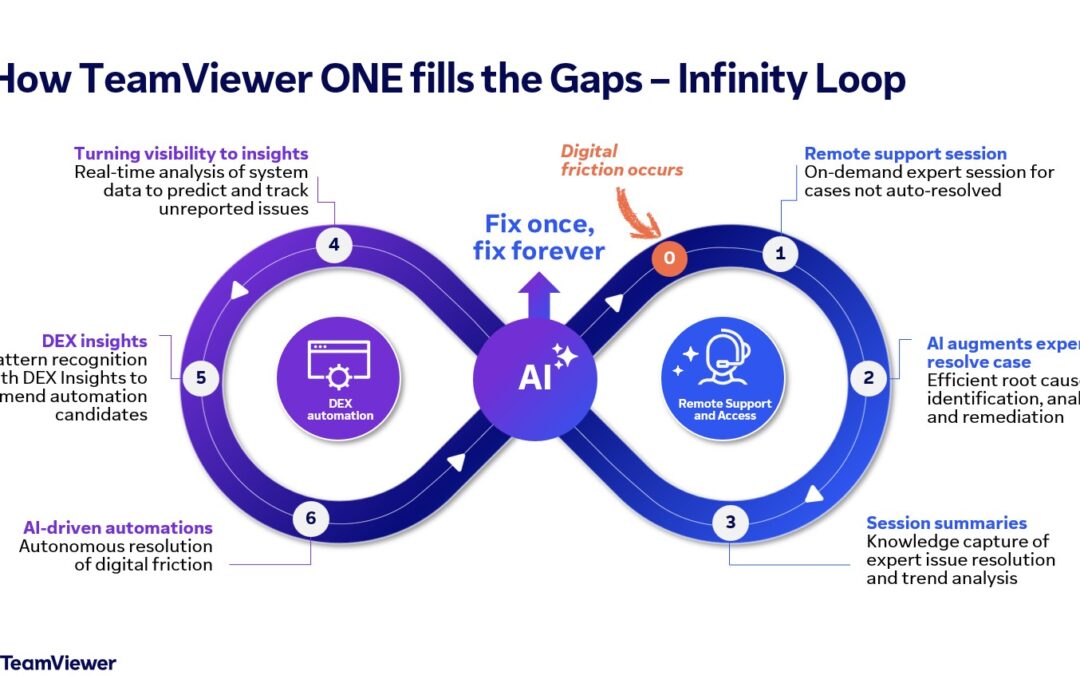
1. Remote Support Session: TeamViewer’s platform begins with on-demand expert sessions tailored for cases that resist auto-resolution or are “new” issues within an environment. This foundational step ensures that no problem is too remote to address, literally and figuratively.
2. AI Augmentation: AI plays a pivotal role, enhancing an expert’s ability to identify root causes swiftly and accurately during this remote session. The AI-driven augmentation ensures that the expert’s interventions are precise, impactful and timeous.
3. Session Summaries: The loop captures knowledge with detailed session summaries, facilitating trend analysis and enhancing future interventions. This creates a repository of insights, turning every session into a learning opportunity. TeamViewer is actively harnessing AI to suck knowledge out of engineers, without them even realising it.
4. Visibility to Insights: Real-time system data analysis is key. TeamViewer transforms visibility into actionable insights, predicting and tracking issues before they escalate into disruptions.
5. DEX Insights: Pattern recognition within the DEX framework identifies automation candidates, optimizing processes and minimizing friction before it even occurs.
6. AI-driven Automations: Autonomous resolutions are where the loop closes. Learning opportunities and insights identified in step 3 are transformed into proactive automations deployed across the remainder of the estate, allowing digital frictions to be resolved without human intervention. This not only saves time but also empowers end-users with a smooth, uninterrupted experiences.
Competitive Edge
In a market teeming with alternatives, the holistic nature of TeamViewer One’s approach sets it apart. By seamlessly integrating remote support with proactive DEX strategies, TeamViewer not only addresses immediate issues but anticipates future needs and prevents repetitive disruption. Competitors often offer either robust remote solutions or advanced DEX capabilities, but never both in such a cohesive manner.
The result is a platform that doesn’t just react to problems but actively prevents them, enhancing overall productivity and satisfaction. This strategic positioning transforms the conumdrum into a distinct competitive advantage.
Conclusion
The Infinity Loop is more than a process; it is a paradigm shift in how service delivery is perceived and executed. By converting the remote support conundrum into an opportunity for innovation, TeamViewer has positioned itself uniquely in the end-user computing market. The integrated capabilities of remote support and DEX insights within the TeamViewer One Platform not only resolve existing challenges but also redefine the possibilities for future service delivery.
In essence, the TeamViewer Infinity Loop exemplifies how turning a conundrum into a competitive advantage isn’t just a strategic move—it’s a transformative vision for the future of end-user computing.