
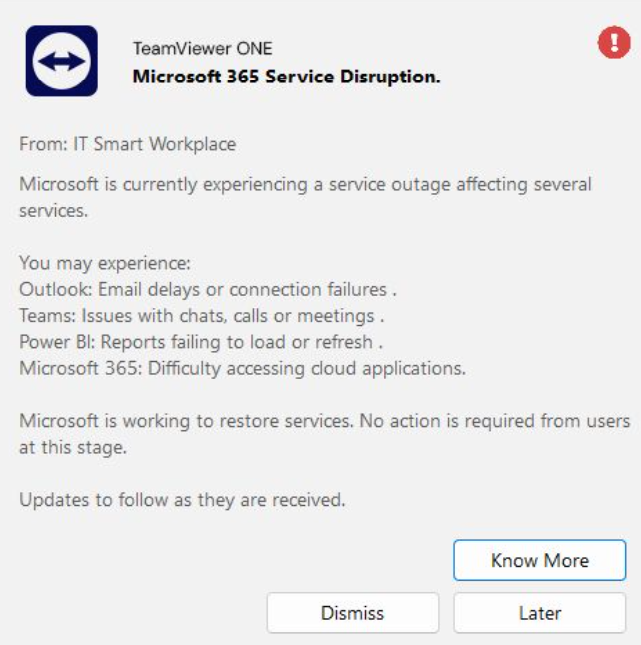
In the race to embrace the cloud, modern enterprises have traded complex on-premise infrastructure for the sleek convenience of Software-as-a-Service. Yet, when a major provider stumbles, that convenience quickly turns into a glaring vulnerability. The recent Microsoft outage serves as a stark reminder of this reality. When core services like O365, Teams, and Intune went down, countless organizations found themselves effectively blind and muted.
For decades, IT architecture lived by a simple golden rule: never build a single point of failure. Who remembers architecting redundant WAN links in the early 90's? Today, however, it seems the enterprise has developed a collective amnesia around redundancy. By consolidating identity, communication, and endpoint management under a single SaaS vendor, businesses have inadvertently recreated the very single points of failure they once engineered so hard to avoid.
When a unified ecosystem goes offline, the operational fallouts cascade rapidly. During the Microsoft disruption, the loss of Teams and email severed primary communication channels with end users. As a result, IT departments could not easily send mass updates to employees, leaving staff confused and productivity stalled. Even more concerning for the enterprise was the disruption to Intune. When cloud-based endpoint management goes down, IT teams lose visibility and control over their estate. Without active policy enforcement and monitoring, remote and hybrid devices are suddenly exposed to configuration and compliance drift. Security patches are delayed, settings cannot be verified, and the organization's overall attack surface quietly expands while engineers wait for a third-party status page to turn green.
True operational resilience requires decoupling your safety net from your primary productivity suite. If your emergency communication tool and your device management platform live on the exact same infrastructure as your daily email, you do not have a contingency plan. You simply have a shared vulnerability.
During the outage, our clients running TeamViewer DEX experienced a very different reality. Because their endpoint management and additional communication tools operated independently of the affected SaaS ecosystem, business continuity remained intact. While primary chat apps and inboxes were unreachable, IT teams used TeamViewer DEX announcements to broadcast critical updates directly to employee screens. At the same time, they continued to enforce policies, monitor device health, and prevent compliance drift through the same resilient infrastructure. Lest we forget that at some point TeamViewer may experience an outage in the future as well, but the lesson remains the same.
Relying on a single SaaS vendor for every mission-critical function is a gamble with high stakes. Cloud providers offer incredible scale and efficiency, but no platform is immune to downtime. Enterprises must wake up from their redundancy amnesia and rethink how they architect resilience. By diversifying core tooling and maintaining independent channels for endpoint control and staff communication, IT leaders can ensure that when one giant falls, their business stays standing.